

AI app builder comparison · 2026
Xroga vs Lovable (2026): Which AI App Builder Fits Your Project?
Building the first version of an app with AI is becoming easier. The more important question is what happens after the first prompt. We compare Xroga and Lovable across new app creation, existing repositories, GitHub, validation, previews, publishing, code ownership and the work that follows version one.
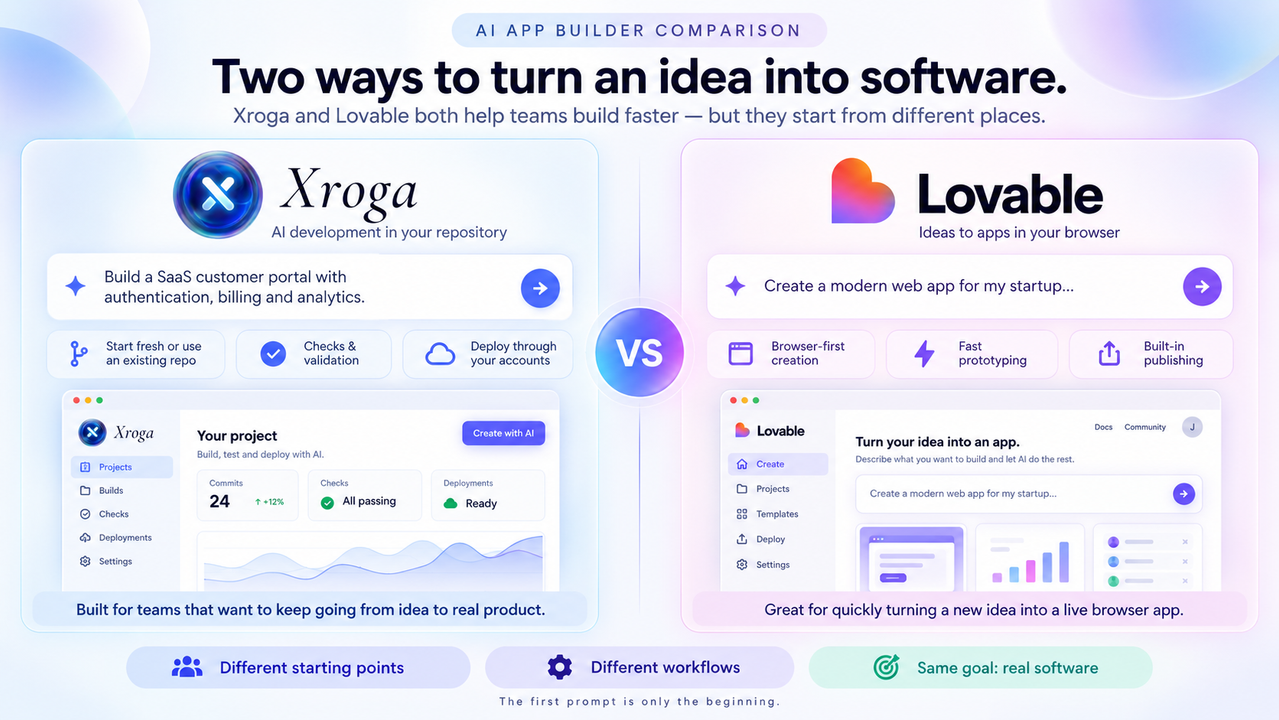
The 30-second answer
The first prompt is only the beginning.
Lovable is especially compelling when the job starts with “I have an idea — build me a web app.” Its browser-first workflow compresses generation, preview, iteration and publishing into one approachable environment.
Xroga becomes more differentiated when the job is “build this product — and keep working with the software after the first version.” Xroga can start from a prompt or an existing repository, reuse project architecture, run applicable checks, expose preview and review evidence, and work through accounts you authorize.
The useful decision is not simply which AI generates code. It is where your project begins, where the code lives, and what must happen after generation.
01 · Quick comparison
Xroga vs Lovable at a glance
Both products can turn natural-language requirements into working software. Their biggest differences are the starting point, the relationship with the repository, how validation is surfaced, and how publishing fits into the workflow.
| Decision | Xroga | Lovable | Why it matters |
|---|---|---|---|
| Starting point | New idea or existing repository | New Lovable project | Matters when software already exists before the AI task starts. |
| Interaction | Natural-language outcome | Natural-language app creation | Both reduce the need to start from raw code. |
| Existing external repo | Supported starting point | Existing GitHub repo import is currently unsupported | One of the clearest differences for established projects. |
| GitHub | Repository-aware work, branches and reviewable changes | Two-way Git sync, branches, local cloning and PR workflows | Both support GitHub, but they enter it differently. |
| Validation | Applicable project checks and visible blockers | Built-in security scans and project checks | “Generated” and “verified” should not be treated as the same state. |
| Preview | Preview attached to project/build state | Integrated browser preview and iteration | Both shorten the feedback loop. |
| Publishing | Authorized provider accounts when configured | Built-in Lovable publishing and hosting | Different trade-offs between convenience and provider ownership. |
| Code ownership | Inspectable repository/source | Lovable states that users own generated code | The bigger distinction is workflow, not whether code can be owned. |
Lovable deserves an important clarification here: it is not a “no GitHub” product. Lovable currently supports two-way Git synchronization, branch operations, cloning and pull-request workflows. Its documented limitation is more specific: importing an existing GitHub repository into Lovable is currently unsupported, and connecting a project creates a new repository. Lovable GitHub documentation
02 · Lovable's strengths
What Lovable genuinely does well
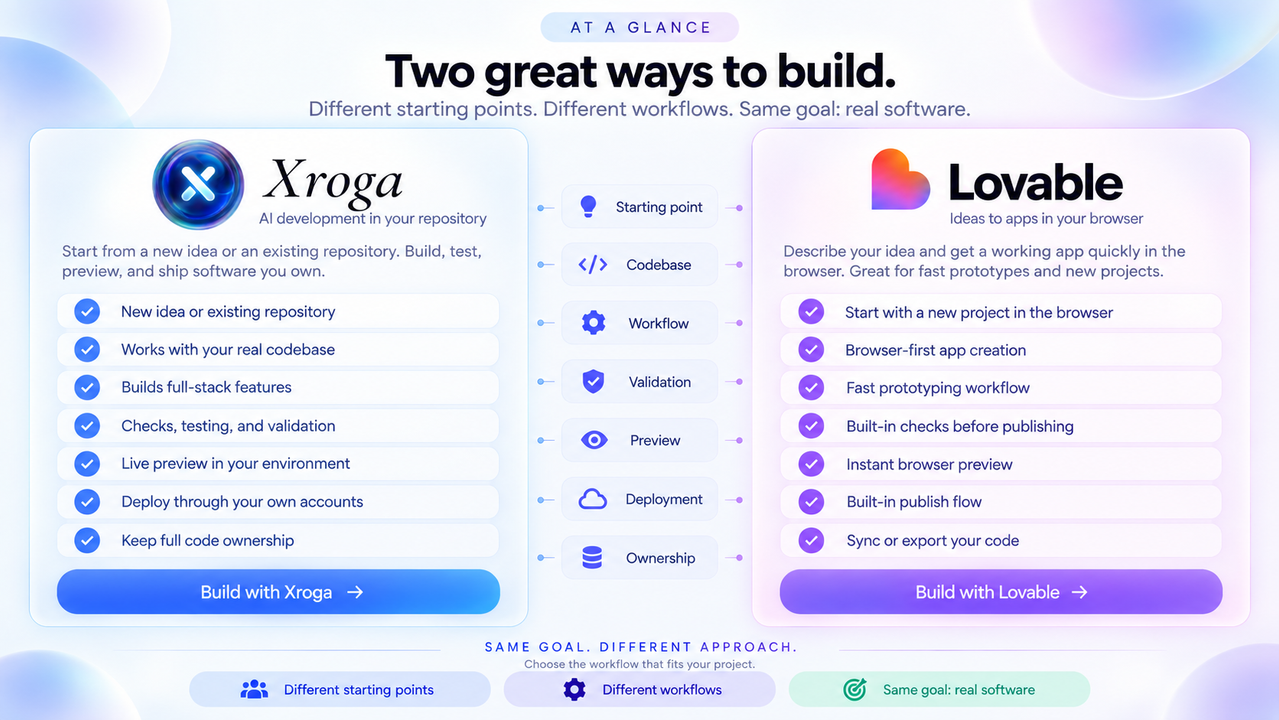
Competitor comparison pages become hard to trust when every paragraph exists to make the other product look weak. Lovable became popular for a legitimate reason: it makes the first mile of web-app creation unusually approachable.
A user can describe an application, iterate inside the browser, see the result quickly and publish without first building a traditional local development environment. Lovable's current publishing documentation describes a two-click first-publish flow, a suggested lovable.app address and a Basic security scan in the publishing dialog. Paid plans can add custom domains. Lovable publishing documentation
Fast browser start
Describe a new application and begin building without first setting up a local project.
Integrated preview
The generation and visual feedback loop happens inside the same product.
Built-in publishing
A hosted URL and publishing workflow are already part of the product.
Lovable is also much more portable than an old-fashioned closed no-code platform. Its Git integration lets users keep a GitHub copy, collaborate through branches and pull requests, clone locally and continue in another IDE. Lovable's pricing page also explicitly states that users own their generated projects and code. Lovable pricing and ownership
That means Xroga should not be positioned as “the product that finally gives you code.” Lovable already gives users code. The more interesting difference appears when the code already exists before the AI task starts.
03 · Starting point
Where the workflows begin to diverge
Imagine that your product already has authentication, billing, an API, a database schema, tests, customers and an established visual system.
“Add subscription management to our existing customer portal. Use the billing system already in the project, preserve the current design and run the relevant checks.”
With Xroga, that task can begin with the repository that already contains the product. The current Xroga app-builder and coding-agent workflows are designed to inspect existing architecture, reuse conventions and tests, make focused changes and preserve the project as the continuing source of truth.
Lovable's Git support becomes powerful after a Lovable project exists, but its current official documentation says an arbitrary existing GitHub repository cannot be imported into Lovable as the starting project. Connecting GitHub to a Lovable project creates a new repository and starts synchronization. Lovable Git sync limitations
Starting something new?
Both products are viable.
Continuing software that already exists?
Xroga has the more direct documented starting workflow.
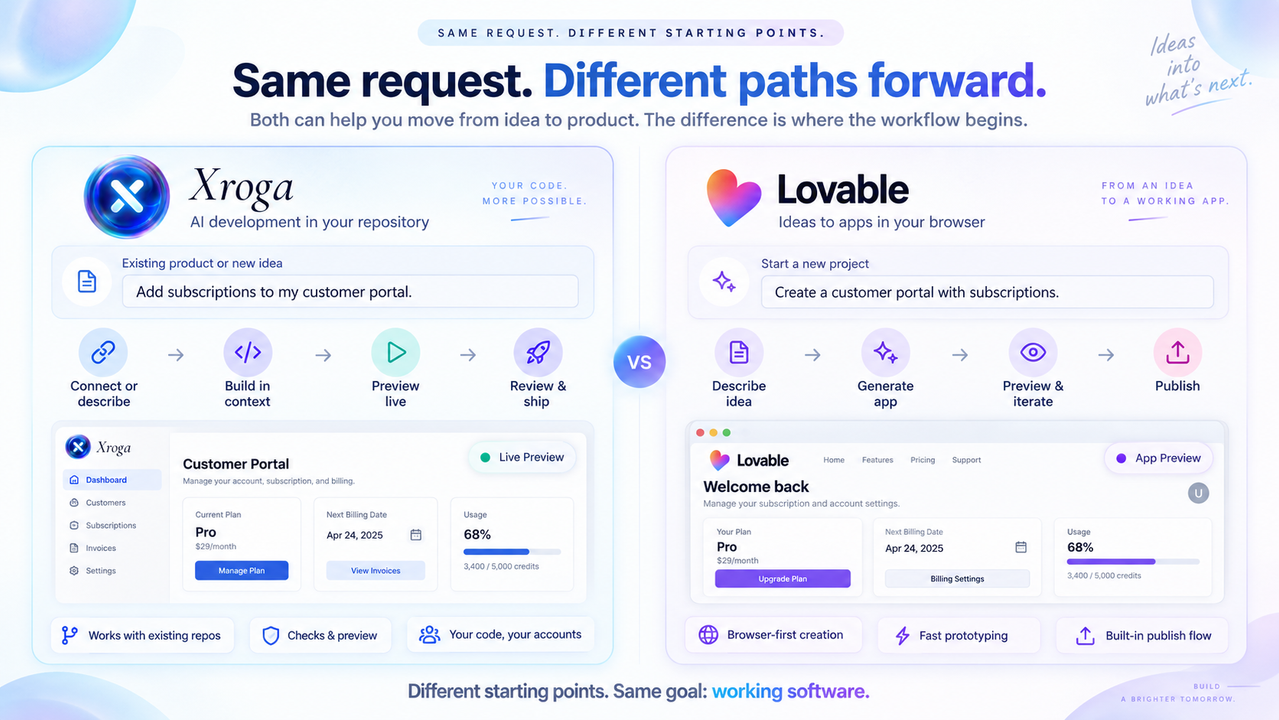
Same prompt. Different relationship with the project.
Lovable's model can be summarized as describe → generate → preview → iterate → publish.
Xroga's repository-centered model can be summarized as describe or connect → implement in project context → verify → preview and review → ship.
The difference looks small in a diagram. It becomes larger over time. Applications accumulate dependencies, data, permissions, customer requests, migrations and release processes. Eventually the question stops being “Can AI generate this screen?” and becomes “Can the team keep changing this product confidently?”
04 · GitHub
Both support GitHub. They do not use it in the same way.
How Lovable approaches GitHub
Lovable's current GitHub integration supports two-way synchronization. Changes made in Lovable can sync to GitHub, and changes pushed to the active synced branch can flow back into Lovable. Users can switch branches, create branches, clone locally and use pull-request workflows. Official GitHub integration
The key boundary is the beginning of the workflow. Lovable states that project code is initially stored and managed in Lovable. When a project is connected to GitHub, Lovable creates a new repository. Its limitation section currently says existing GitHub repositories cannot be imported into Lovable.
How Xroga approaches GitHub
Xroga treats the connected repository as part of the working project state. A request can target the existing codebase, retrieve relevant context, follow current patterns, apply focused edits, run applicable checks and prepare reviewable GitHub work.
The meaningful comparison is therefore not GitHub versus no GitHub. It is GitHub as a project that can be exported and synchronized versus GitHub as part of the project's starting and continuing state.
For a brand-new MVP, the distinction may be small. For a six-month-old SaaS with customers, migrations and an established architecture, it can become one of the biggest factors in the decision.
05 · Verification
What does “done” actually mean?
One of the most dangerous phrases in AI software marketing is “your app is ready.” Ready to preview, ready for a demo, ready for production traffic and ready to process payments are very different claims.
Xroga separates implementation from evidence. Applicable project-defined type checks, tests, builds, runtime checks and preview evidence can determine status. If required provider access or configuration is missing, that should remain a blocker rather than being turned into a success message.
Lovable has also invested significantly in validation and security. Its current security system includes a Basic scan and Deep scan. The Basic scan covers areas such as RLS policy linting, database schema/access review and dependency vulnerabilities. Deep scan adds an agentic review of the application code and additional security patterns. Lovable correctly notes that these tools do not replace a thorough security review. Lovable security documentation
So the accurate comparison is not “Xroga tests and Lovable does not.” Lovable provides real platform security scanning. Xroga's differentiation is that completion can remain attached to the real checks and evidence produced by the connected project.
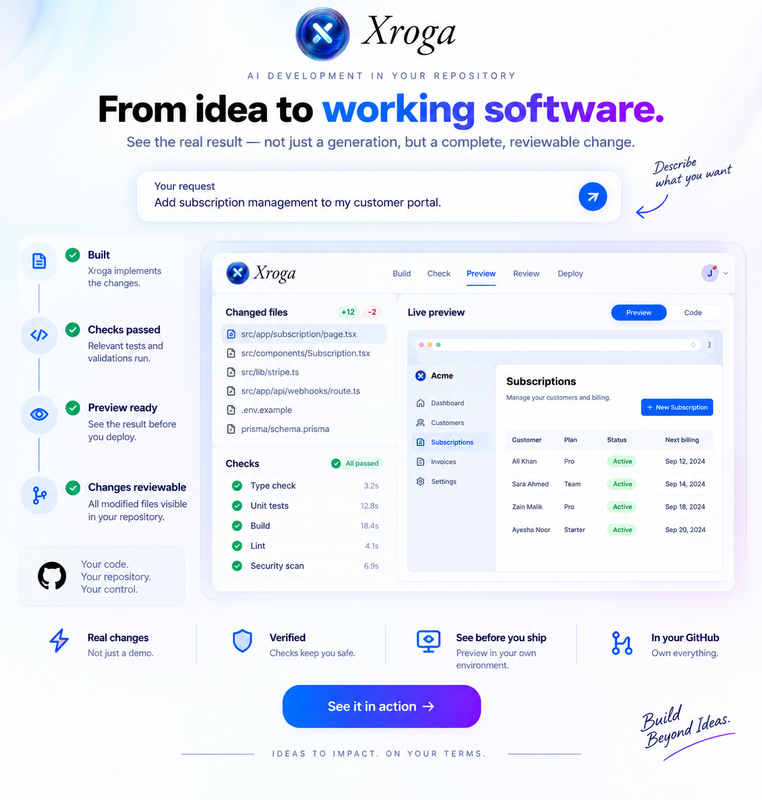
Proof is more useful than a finished message.
For a real implementation request, useful evidence answers concrete questions: what changed, which checks ran, what passed, what failed, what remains blocked, whether the result can be previewed, and which repository contains the work.
That is the part of Xroga's product story that should do the persuasion. The page does not need a “winner” badge when the reader can see what a repository-centered verification workflow is designed to preserve.
06 · Preview and deployment
Both understand the value of seeing the result quickly.
Lovable's browser-first model makes preview and iteration feel especially native: generate the application, inspect it, keep prompting and publish from the same environment.
Lovable's built-in publishing is a genuine convenience advantage. Its documentation describes a two-click first publish, a lovable.app address, automatic Basic security scanning in the publish dialog and custom domains on paid plans. Lovable publish workflow
Xroga keeps preview and deployment as separate pieces of evidence. A visible preview can demonstrate that the application renders in a configured environment; it does not automatically prove that authentication, billing webhooks, migrations, DNS, production environment variables or rollback behavior are correct.
Lovable optimizes for
Publishing convenience
Browser-first generation, integrated preview and a managed route to a hosted result.
Xroga optimizes for
Visible delivery state
Keep code, checks, review state and authorized deployment operations visibly separated.
Neither trade-off is universally better. Someone validating a new idea may value the shortest possible route to a public URL. A team operating an established product may care more about knowing exactly which code and provider state produced that release.
07 · Ownership and pricing
Code ownership is not a Lovable weakness.
Outdated comparison copy often describes browser builders as if users cannot obtain their source code. That would be inaccurate here.
Lovable's current pricing page says users own the projects and code they create. Its Git workflow can keep an external repository synchronized, and eligible paid users can download their codebase directly. Lovable ownership statement
Xroga also makes ownership central. Generated and modified work remains inspectable in a repository, while provider operations happen through accounts the user authorizes.
The more useful question is therefore not “Can I legally own my generated files?” It is “Where does my code live during normal work, and can the next task continue from the project state I already have?”
Xroga vs Lovable pricing in 2026
Xroga
$0 Free$25/month ProXroga's current public product contract uses Free and Xroga Pro. Capacity is measured in Xroga usage/actions, not Lovable credits.
View Xroga pricing →Lovable
Free plan$25/month Pro · 100 creditsLovable offers higher credit tiers as well. Credit usage varies by work performed and should not be mapped one-for-one to Xroga actions.
View Lovable subscription plans“100 credits” and “1,500 actions” are not standardized units. A useful buying test is to run a representative workflow and observe how much real work the included capacity completes rather than manufacturing a value-per-credit winner.
What about native mobile apps?
Lovable's official publishing documentation currently says Lovable publishes web applications to web URLs and does not have a built-in flow that packages and submits a project directly to the Apple App Store or Google Play. Lovable native app publishing FAQ
Xroga lists mobile applications among supported product categories, but native release work can still require project-specific tooling, credentials and store processes. Neither product should imply that a complex store release is automatically complete because a mobile interface was generated.
08 · Decision
Which should you choose?
Consider Lovable when
The browser-first path is the product advantage.
- You are starting a new web application.
- You want very little setup before seeing a result.
- Integrated browser preview is central to your loop.
- Built-in hosting and publishing are more important than provider-level control.
- Lovable's supported web stack fits your product.
Consider Xroga when
The software has a life after generation.
- You already have a repository or application.
- Existing architecture and project conventions should be preserved.
- Your team wants project-defined checks and visible blockers.
- Changes should remain reviewable in GitHub.
- Deployment should stay attached to accounts your team controls.
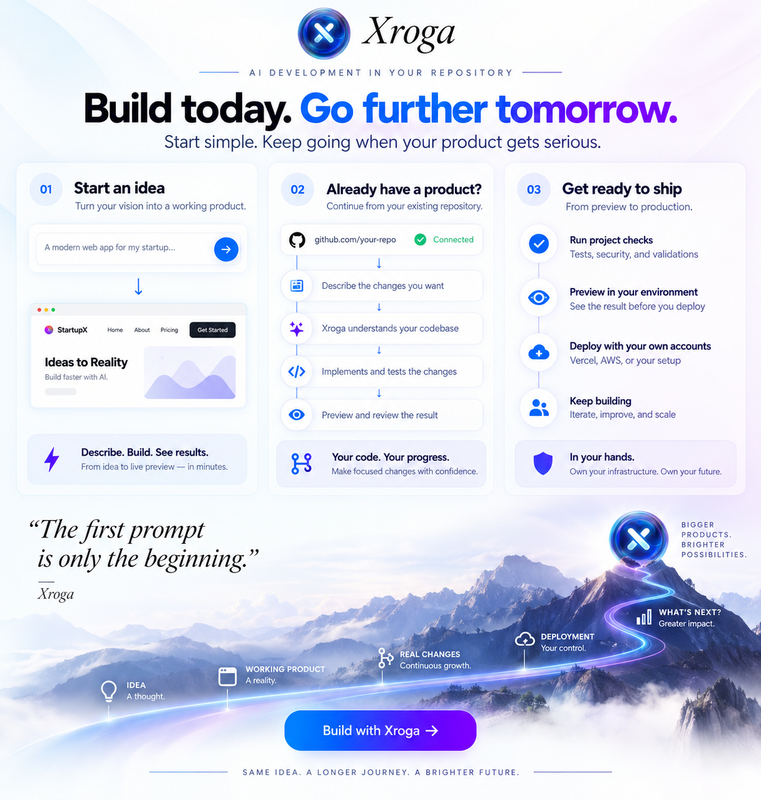
The first prompt is only the beginning.
A product rarely stays a prompt. The first version attracts users. Users create requirements. Requirements create changes. Changes create regressions. Teams create review processes. Growth creates operational constraints.
Eventually, “Can AI generate this?” becomes a less important question than “Can AI help us keep building it?”
Our conclusion
Lovable shortens the distance from idea to first web app. Xroga is designed to keep shortening the distance after that.
Choose Lovable when browser-first creation and integrated publishing are the highest priorities. Consider Xroga when you want the same natural-language starting point but need the work to remain connected to an existing or inspectable repository, project-defined checks, reviewable source changes and provider accounts you control.
For a prototype you may discard next week, the distinction might not matter. For software you expect to maintain next year, it increasingly can.
09 · FAQ
Questions people ask about Xroga vs Lovable
These answers cover the search questions that usually matter once someone moves beyond a generic “which is better?” comparison.
Is Xroga better than Lovable?
It depends on the workflow. Lovable is particularly strong for starting new browser-based web apps quickly. Xroga is a stronger fit when work needs to begin from an existing repository, remain reviewable in GitHub, run project-specific checks, or continue through provider accounts the team controls.
Can Lovable import an existing GitHub repository?
Not currently. Lovable supports extensive two-way GitHub synchronization after a Lovable project exists, but its official GitHub documentation currently says importing an existing GitHub repository into Lovable is unsupported.
Does Lovable support GitHub?
Yes. Lovable supports two-way Git synchronization, branch switching, branch creation, local cloning and pull-request workflows. The important limitation is where the workflow begins: connecting a Lovable project creates a new repository rather than importing an arbitrary existing repository.
Can Xroga work with an existing repository?
Yes. Xroga can start from an authorized GitHub repository, inspect existing architecture, make focused changes, run applicable project checks and prepare reviewable repository work.
Does Lovable let you own your code?
Yes. Lovable states that customers own the projects and generated code they create. It also supports Git synchronization and codebase download on eligible plans.
Is Lovable good for production apps?
Lovable includes hosting, custom domains, Git synchronization and built-in security scanning, so it should not be described as a prototype-only tool. Production fit still depends on the application architecture, permissions, data model, integrations, checks and operational requirements.
Can Lovable publish native iOS or Android apps?
Lovable currently publishes web applications to web URLs. Its official publishing documentation says there is no built-in flow that packages and submits a project directly to the Apple App Store or Google Play.
How much does Lovable cost in 2026?
Lovable currently lists Pro at $25 per month for 100 monthly credits, with larger credit allocations available. Credit consumption depends on the work performed, so Lovable credits should not be treated as directly equivalent to Xroga actions.
Which is a better fit for an existing SaaS product?
Xroga has the more direct documented workflow when the existing repository itself is the starting point. Lovable has strong Git synchronization after a Lovable project exists, but its current documentation does not support importing an arbitrary existing GitHub repository as that starting project.
Methodology
How this comparison was researched
This page was reviewed against current public product documentation on September 23, 2026. Lovable claims are sourced primarily from Lovable's official GitHub, publishing, security, subscription and pricing documentation. Xroga claims are tied to current Xroga product pages, source configuration and verified public capability contracts.
We did not run a controlled speed, code-quality or reliability benchmark for this article. A future benchmark should give both products the same task, acceptance criteria and project context, then publish the methodology and observed results alongside the conclusions.
Primary sources
Verify the product facts yourself
AI software products change quickly. These are the primary pages used for the comparison and should be checked again when making a purchasing decision.